
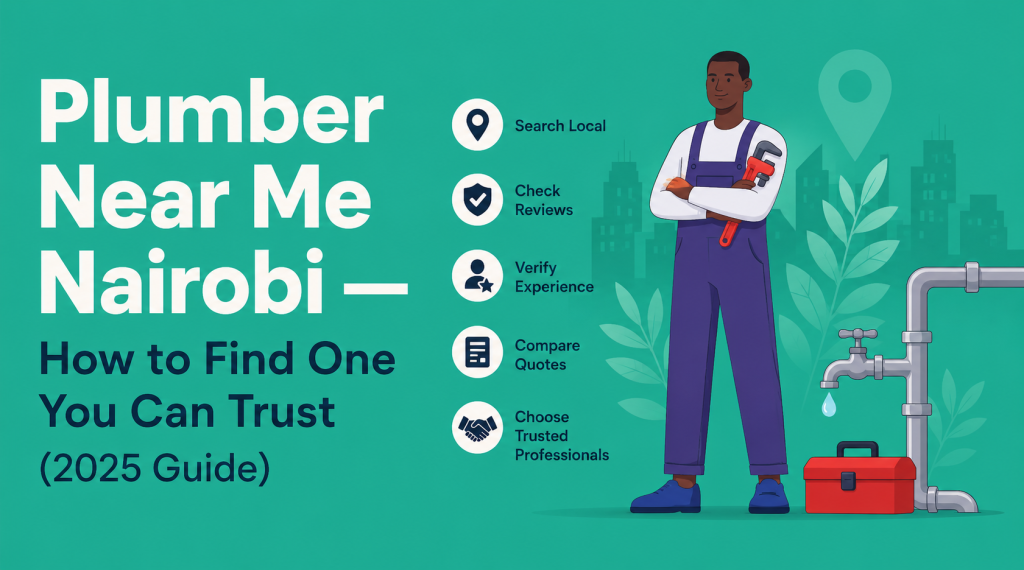
Picture this. It’s 10:30pm on a Tuesday. You walk into your bathroom and the floor is wet. You look under the sink — a pipe joint is dripping steadily. Or worse, you wake up to no running water and realise the overhead tank has a crack. You grab your phone and type “plumber near me Nairobi”.
And then the anxiety starts.
Who do I call? How do I know they won’t overcharge me? What if they make it worse? Can I trust a random number from Google?
If that sounds familiar, you are not alone. Finding a reliable plumber in Nairobi is genuinely hard — and not because there aren’t enough of them. There are thousands. The problem is knowing which ones are actually good at their job and honest about their pricing.
This guide is for you. By the time you finish reading it, you will know exactly how to find, vet, and hire a plumber in Nairobi without the usual stress — whether you need someone in the next 20 minutes or you’re planning ahead.
Table of Contents
Why Finding a Good Plumber in Nairobi Feels Like a Lottery
Let’s be honest about something most websites won’t say: the Kenyan plumbing market is largely unregulated at the grassroots level. Almost anyone can show up with a wrench and call themselves a fundi wa maji. This isn’t an attack on plumbers — the majority are honest, hardworking people. But it means you can’t simply trust a title.
Here’s what homeowners across Nairobi consistently run into:
- Wildly inconsistent pricing. One fundi quotes Ksh 500 to fix a dripping tap. Another quotes Ksh 3,500 for the exact same job. Neither of them is necessarily lying — but you have no baseline.
- The disappearing act. You agree on a price, they start work, then they discover “a bigger problem” that somehow requires twice the original quote.
- Parts marked up beyond recognition. A fundi buys a ball valve at the hardware for Ksh 120, then bills you Ksh 600 “for the part.”
- No accountability. If something goes wrong after the job, there’s no company to call back. The personal phone number is switched off.
None of this means you should panic. It means you need a system for finding and hiring — which is exactly what we’re going to give you.
The 5 Ways Nairobi Homeowners Find a Plumber (And What Actually Works)
1. Asking Neighbours or Your Estate WhatsApp Group
Verdict: The best starting point — if the recommendation comes with real details.
Word of mouth from someone who actually paid a fundi and had a good result is gold. The problem is that most WhatsApp recommendations look like this: “Nilikuwa naye mwaka jana, alifanya vizuri. Niko na nambari yake.” That’s helpful, but “did good work a year ago” doesn’t tell you what he charges today, whether he shows up on time, or whether he knows how to handle your specific problem.
When you get a recommendation from a neighbour, ask these three follow-up questions:
- When did you last use them?
- What exactly did they fix?
- Did they quote you a price before starting?
2. Googling “Plumber Near Me” or “Plumber in [Your Area]”
Verdict: Useful, but you need to know how to filter the results.
Google will show you a mix of legitimate contractors, agencies, and sometimes outdated listings. The Google Maps section (the “Local Pack” — the map with 3 businesses highlighted) is usually the most relevant.
Look for:
- Businesses with 10+ Google Reviews (not just a star rating with no reviews)
- A verified address — not just a P.O. Box
- A phone number that is answered when you call during business hours
Pro tip: If a listing says “24/7 Emergency Plumber Nairobi” but nobody picks up at 3pm on a Wednesday, that should tell you something.
3. Facebook Groups and Social Media
Verdict: Works, but comes with risks.
Groups like Nairobi Homeowners & Renters or neighbourhood-specific groups can throw up great recommendations. The risk is that you often can’t verify who is vouching for whom — some recommendations are genuine, some are from the fundi’s own friends.
If you go this route, look at the replier’s profile, check how long they’ve been in the group, and always DM to ask for more details before calling.
4. Asking at a Hardware Store
Verdict: Underrated and often brilliant.
This is one of the most reliable low-tech methods in Nairobi. Walk into your nearest hardware store (Kitengela Hardware, Magunas, a local stockist) and say: “Mnatoa fundi wa maji mzuri?” Hardware owners know the local fundis by name. They see who actually comes in to buy quality parts. If a plumber is good, the hardware guys will tell you. If he’s known for dodgy work, they’ll quietly tell you that too.
5. Using a Verified Fundi Directory
Verdict: The most reliable option when you don’t have a personal recommendation.
A verified directory gives you something the other methods don’t: structured information you can compare. You can see location, specialisation, reviews from multiple customers, and contact details — all in one place.
Browse verified plumbers near you on Fundi Flani →
Our directory only lists fundis who have been submitted with real contact details and are reviewed by actual customers. You can filter by your area, read what others have experienced, and make an informed decision before you pick up the phone.
How to Quickly Check If a Plumber Is Legitimate
You’ve found a name. Before you let them through your door, do a 5-minute check:
Ask for Their Name and ID
Not their business card — their actual name and phone number. If they are hesitant to give you their name, that’s a red flag. Legitimate fundis have nothing to hide.
For larger jobs (full bathroom installation, pipe replacement), ask if they are registered with the National Construction Authority (NCA) of Kenya. NCA registration isn’t required for small repairs, but it’s a good sign for bigger projects.
Get At Least Two Quotes
For any job over Ksh 2,000, call two different fundis. You don’t have to be sneaky about it — it’s completely normal practice. This also gives you a price anchor: if one quote is wildly higher or lower than the other, you know to ask why.
Agree on Price BEFORE Work Starts
This sounds obvious, but it’s where most homeowners get caught out. “We’ll figure out the price once I see the job” is a phrase that should make you uncomfortable. Push for a number — even a rough estimate — before work begins.
Say: “Niambie bei kabla hujaanza kazi, hata kama ni rough estimate.”
Never Pay 100% Upfront
For parts that need to be bought, it’s reasonable to pay for the parts in advance. Labour? Pay when the job is done, or split it: 30% to start, 70% on completion for bigger jobs.
What You Can Expect to Pay — A Realistic 2025 Price Guide
Prices vary by area, complexity, and who you hire. Use these as a sanity check, not a hard rule:
| Job | Typical Range (Nairobi) |
|---|---|
| Fix a dripping tap | Ksh 400 – 800 |
| Unblock a drain (minor) | Ksh 800 – 1,500 |
| Fix a running toilet | Ksh 600 – 1,200 |
| Replace a ball valve / float | Ksh 500 – 1,000 + parts |
| Fix a burst pipe (minor) | Ksh 1,500 – 3,500 |
| Install a new sink | Ksh 2,000 – 5,000 + parts |
| Install a water heater | Ksh 3,000 – 8,000 + parts |
| Full bathroom plumbing (new house) | Ksh 25,000 – 80,000+ |
Tip: Always ask whether the quoted price includes parts, or if parts are separate. Most fundis quote labour only.
For a deeper look at pricing across different jobs, see our full guide: How Much Does a Plumber Cost in Kenya? 2025 Price Breakdown → (coming soon)
Emergency Plumber in Nairobi — What to Do When It Can’t Wait
A burst pipe or a flooded bathroom doesn’t care that it’s midnight. Here’s how to handle an emergency calmly:
Step 1: Stop the water first. Before you do anything else, turn off your water supply. The main stopcock is usually near your water meter (outside the building, or under the kitchen sink). If you can’t find it, close the overhead tank tap first to stop new water coming in.
Step 2: Contain the damage. Put down towels, move valuables, and take a quick photo. The photo is useful if you need to claim on home insurance later.
Step 3: Call a fundi you’ve already identified. This is why it pays to have a plumber’s number saved before an emergency happens. Fundis who offer genuine 24-hour service do exist — but verify this when you’re calm, not at 2am.
Find emergency plumbers available now →
Step 4: While you wait, keep the fundi updated. Tell them exactly what you see — not just “there’s a problem with my pipe.” The more specific you are, the better prepared they’ll arrive.
How to Find a Plumber in Your Part of Nairobi
The best fundi for your home is usually one who is nearby and knows your type of building. Here are direct links to area-specific listings on Fundi Flani:
- Plumbers in Westlands & Parklands
- Plumbers in Kilimani & Kileleshwa
- Plumbers in Kasarani & Ruaraka
- Plumbers in Embakasi & Utawala
- Plumbers in Karen & Langata
- All Nairobi Areas →
Frequently Asked Questions
How much does a plumber cost in Nairobi?
Most standard plumbing repairs in Nairobi cost between Ksh 500 and Ksh 3,500 in labour, depending on the complexity of the job. Parts are usually charged separately. Always ask for a quote upfront before work begins.
How do I find a reliable plumber in Nairobi?
The most reliable methods are: a recommendation from a neighbour who has used the plumber recently, asking at a local hardware store, or using a verified directory like Fundi Flani where you can read reviews from other homeowners.
Is there a 24-hour emergency plumber in Nairobi?
Yes, several fundis in Nairobi offer emergency call-out services. You can find fundis who list emergency availability on the Fundi Flani directory. It is always worth saving an emergency plumber’s number before you actually need one.
Should I pay a plumber before or after the job?
For small jobs, pay after completion. For bigger jobs requiring materials, it’s reasonable to pay for parts upfront and labour upon completion. Avoid paying 100% of labour fees before any work has been done.
What questions should I ask a plumber before hiring them?
Ask: What is the total cost (labour + parts)? How long will the job take? What happens if there’s a problem after the job is done? Can you give me a written quote? For bigger projects, also ask about their experience with your specific type of job.
Do plumbers in Nairobi need to be registered?
For larger construction or infrastructure projects, registration with the National Construction Authority (NCA) is required. For everyday household repairs (fixing a tap, unblocking a drain), there is no mandatory registration — which is why using a vetted directory with real reviews is so important.
The Bottom Line
Finding a good plumber in Nairobi isn’t about luck — it’s about having the right process. Get a name from someone who has actually used them. Ask for a price before work starts. Don’t pay everything upfront. And if you don’t have a personal recommendation, use a directory that has done the vetting for you.
The panic of a plumbing emergency will pass a lot faster when you have a trusted fundi’s number already saved.
Ready to find a reliable plumber near you right now?
👉 Search the Fundi Flani Directory → Browse verified plumbers by your Nairobi neighbourhood — read real reviews, compare, and call direct.
About This Article
Written by the Fundi Flani editorial team. Fundi Flani is Kenya’s leading online directory for verified home-service professionals. We help homeowners across Nairobi and beyond find trusted fundis — without the guesswork.
External sources referenced: National Construction Authority of Kenya · Kenya National Bureau of Statistics — Construction Sector